
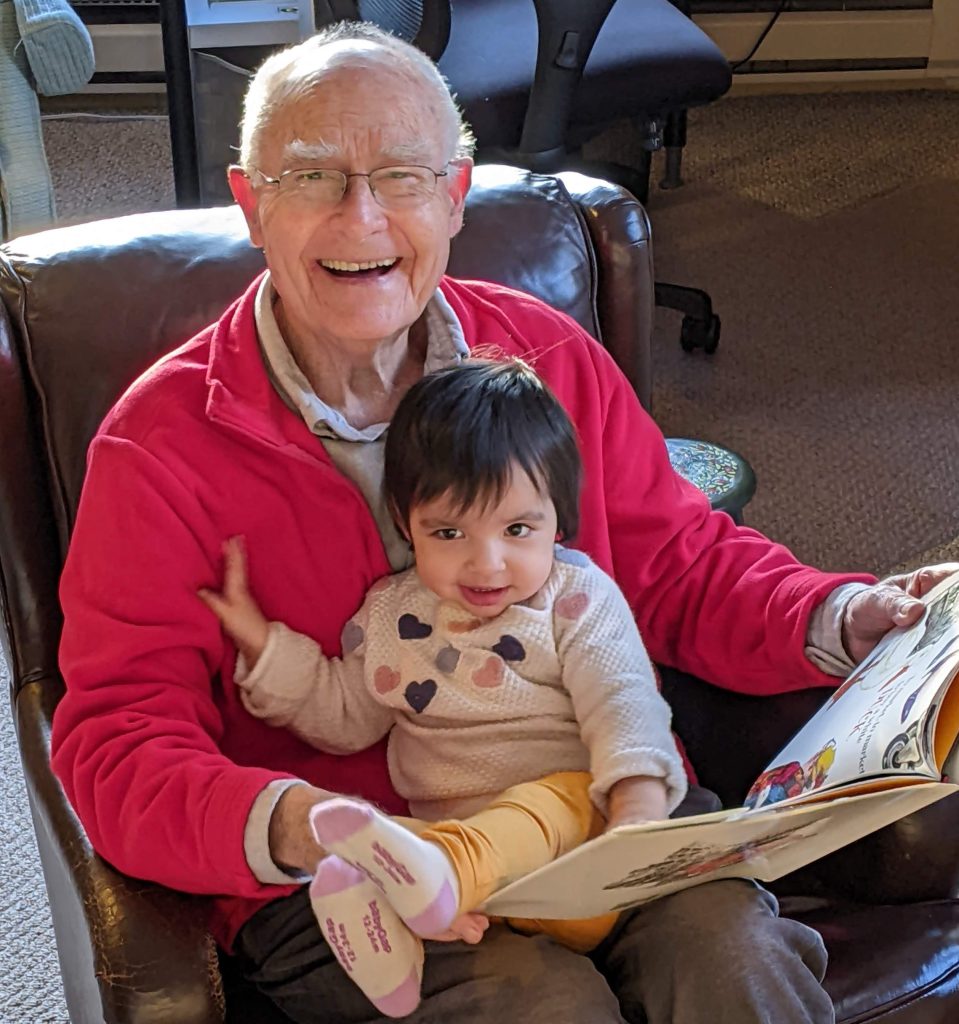
It’s tempting after a long, varied and rewarding career to share too much. I’ve set myself the goal of offering (and then from time to time rotating) just a few items that mean a lot to me and may be of interest to you. A little personal history for context, a few sermons and articles that represent what I feel most strongly about, and some resources and links you may find helpful.
My Background
Upbringing and Religious Background
I was born in South Africa into a staunchly Roman Catholic family. Ahead of my ordination to the priesthood, an older brother and an older sister had each entered religious orders. I entered seminary to study for the priesthood at the very young age of 17 and was “ready” (not really) for ordination at the age of 22. Rome’s rule for the minimum age for ordination is 24. Rome made an exception and gave my bishop permission to ordain me at age 23. As a result I was the youngest ever to be ordained in South Africa. In retrospect a dubious honor indeed, and not a good idea.
Education
My entire schooling all the way through High School was in Catholic Schools. This included the final eight years at a Jesuit run boarding school. I went straight from High School to Seminary. My parents liked the idea but “wondered’ if I might perhaps want to wait a while before taking that step. In retrospect a good idea. The seminary was not yet officially affiliated with the Gregorianum University in Rome and was therefore not able to award degrees. The brighter students (not me) were permitted to combine their seminary diploma studies with the pursuit of a degree at a nearby University. Later when I needed to establish a career apart from priesthood I had some catching up to do and managed to get a BA (Social Science) studying part-time while working full time.
Career and Critical Turning Points
It was nerve-wracking and not easy to get my first job after resigning from the active ministry. Nerve-wracking because priesthood was the only thing I was trained for. Difficult because my rejections were based on being “over-qualified”! Understandably it was difficult for prospective employers to know what to do with this guy who had some solid studies behind him but no “secular” experience. After a few discouraging months I was lucky to find something which I was both good at and thoroughly enjoyed. Dean of Students at a Distance-Learning college. A bonus was that my new boss was quite a celebrity on the radio in South Africa. (We had no TV.) He was one of the brilliant “three wise men” on a quiz show in which listeners sent in questions to try to stump the three wise men. They seldom did. He was also politically aligned with me and allowed me to use the college’s study materials in illegal (because of apartheid) study groups in which we tried to help Blacks supplement the inferior education given to them in government schools. My subsequent career as a Licensed Social Worker was beginning to “brew” at this stage because my Social Science degree required internships including one in the now famous Soweto. My supervisor in that internship was later killed in the Soweto riots.
After coming to the USA on a scholarship and earning the Master of Social Work (MSW) degree and later the Doctor of Ministry (D.Min) degree I enjoyed a long and rewarding career as a Licensed Clinical Social Worker and Certified Pastoral Psychotherapist.
The following are among the critical turning points in my life and my career. They have been important in my own growth and in the development of my convictions. So why continue to dwell on them now?! The late John O’Donohue (Celtic spiritual writer) has a great suggestion for enriching our lives as we grow older. Build yourself an “altar of memories”. Cherish, honor and enshrine your memories so that they become much more than mere reminiscences. Let those memories be treasured icons on your memory shrine still beckoning you to ongoing learning, growth, gratitude and joy.
- Somehow getting through the anguish and confusion of leaving first the Roman Catholic priesthood and later the Catholic Church itself and being able to “come unstuck” and keep growing spiritually. Tears and a breakthrough when my spiritual director said it seemed like in a sense I left the Catholic Church long ago but had never grieved the loss of that relationship. For all the problems and disagreements with it, the Church and I were nevertheless in a long and meaningful relationship, even a nurturing and mothering one, and I had never grieved the loss of that relationship. I was able to grieve and begin the moving on process. (I often wonder how many so-called “lapsed” Catholics leave for sincere and conscientious reasons but lack the support they need to move on in a positive and growth-producing way.)
- Joining the justice-seeking anti-apartheid “Christian Institute” in South Africa, knowing its founder the heroic Beyers Naude, and getting to know and work with persons of many different faiths and persuasions who put their own safety aside to work against injustice and oppression.
- My Social Work internship in Soweto and my work as a priest in a Black school and poverty stricken out-stations brought me into a new and intimate relationship with black people and the oppression they were suffering at the hands of the Apartheid government.
- Being asked by the lone progressive and courageously outspoken anti-apartheid member of the white parliament, Helen Suzman, to research, report, and help her expose a nefarious unjust scheme to resettle people in frightful conditions in the area where I worked. Helen’s quoting from the report angered and embarrassed government leaders and that was a good thing.
- Being slammed up against the hood of my car by police, with our school’s Black cook Mrs Tseleng right next to me enduring the same. I was driving her home because of a bad storm and forced off the road by a police van. They implied that we must be in an illegal black/white relationship because I refused to have her sit in the back seat. I understood then in a much deeper way than I ever had before, how Blacks in South Africa faced this kind of treatment on a regular basis.
- Winning an International Education Scholarship to study in the USA
- Arriving at Rutgers after an 8,000-mile journey to discover that a substantial contingent of students were protesting my admission as a white South African and advocating for me to be sent packing. The painful but growth-producing resolution of this through listening, dialog and sharing.
- Meeting, marrying and raising a family with my beloved spouse Jane.
- Being offered a job by Catholic Social Services for which I was well-suited and about which I was enthusiastic; only to have the offer rescinded when it reached the Cardinal’s desk who said: “We don’t hire ex-priests!”
- Writing a book called Justice-Love which helped me gather together and express some of the enthusiasms, challenges and convictions of my life.
Convictions about the Wisdom that Leads to Peace and Justice
The need for quiet reflection and less spoken or written words. Influenced by Buddhism’s “not knowing” which is also called “beginner’s mind”. The practice of “not knowing” or “beginner’s mind” (full of wonderful childlike curiosity with more questions than answers) helps a person cultivate a detachment from grasping for answers (expertise) for the sake of safety. It encourages an openness to not having all the answers. I have been influenced also by Western human development theorists who have shown that being able to live without all the safe answers, to live with ambiguity, is really an advanced stage of maturity. Whereas grasping for the safety and consolation of “unquestionable” truths suggests some of the fear and neediness that is often part of an earlier stage of development. Words and concepts can get in the way of discovering the most life-giving contemplations and truths. Knowledge is very different from Wisdom. The mind can easily become cluttered with facts and figures and over-analysis. If not balanced by quiet self-reflection all those facts and figures can become stumbling blocks instead of signposts on the path towards the truth. Words and concepts can become things that it’s easy to trip over on the path towards truth. They can also seduce us into intellectual “deep holes” in which a self-perpetuating swirl of analysis takes place leading to a glut of knowledge (not wisdom) that doesn’t make life or the world any better. Especially it doesn’t make anything better for the vast quantity of our brother and sister human beings who need the justice, cooperation and sharing that comes from wisdom. They need justice rather than the competition, divisiveness, immediate claims to “ownership” and subsequent injustice that tends to follow new knowledge when it’s not accompanied by wisdom.
Convictions about Healthy Religion
My faith is based on my convictions about the origin of all religion and how it evolves in either a healthy or unhealthy way. A healthy way that leads to compassionate action for justice, or an unhealthy way in which it becomes fear-based, excessively concerned with self-soothing, and tolerant of unjust and exploitative behavior. The evolutionary emergence of consciousness and self-awareness is followed immediately by two contrasting emotions: Awe (Wonder) and Fear (Dread). “Wow! Existence is pretty cool and exciting!” Followed by: “This is really scary because I could lose it all in a flash!” Religion develops out of attempts to deal with those contrasting emotions. Religion attempts to make meaning and “livability” in the midst of that existential crisis. If religion is allowed to “develop” (not really a development) mostly on the basis of fear it becomes either insipid (a mere pacifier) or angry and aggressive and causes war. But it’s also a problem if religion uses Wonder and Awe inappropriately only to escape from the reality of fear. Then it becomes immature and unrealistic. Mature, healthy religion acknowledges the fear, feels the fear, even embraces it as a necessary part of life, but does not become obsessed with safety. Mature, healthy religion opts for awe, wonder and celebration of life without pretending away the inevitable fear involved in being human. Mature, healthy religion is able to live with the risk of great loss while at the same time celebrating and being profoundly grateful for the gift of life. The deep gratitude for the gift of existence engenders a spirit of compassionate sharing with all of humanity which is the complete opposite of the fear-based grasping and hoarding which leads to the exploitation and oppression of our fellow human beings.