Jesus, looking at him, loved him and said: you lack one thing; go, sell what you own, and give the money to the poor, and you will have treasure in heaven; then come, follow me. Mark 10:17-31.
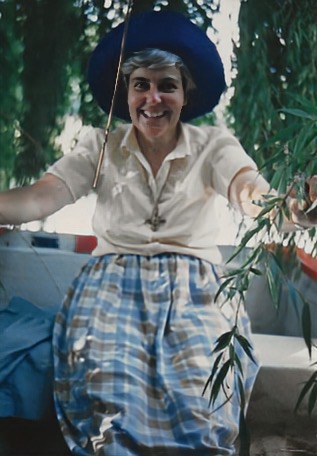
Thanks to all of you for your support, prayers and condolences to Jane and me at the loss of my sister Kathleen. Your love makes it possible to celebrate a life even as we mourn a death. Allow me to celebrate Kathleen’s life by sharing some of that life and its lessons.
As children Kay and I would often daydream together about how we would like our future to be. At that stage we aspired to be farmers. But the farm we planned to share had a richness and productivity that only children could come up with. No specialization for us. We would have horses and cattle and sheep and poultry and maize and numerous other crops all of which were somehow immune from the ravages of drought. Our fantasy farm was very large and very tidy. Some of the farm roads leading to the various fields were even tarred roads. No mud and dust for us!
I often think of those daydreams of perfection and tidiness as symbolic of the control and tidiness so many of us would like to have over our lives and our destinies. As my own life has progressed, the biggest learning has been how it is the messiness (not the tidiness) of our lives that presents the greatest opportunity for growth. I’ve talked before about “kitchen” spirituality. How we grow best in the messiness of the kitchen. I got that from Kay. But oh how we fight against the messy twists and turns don’t we?! We are so upset if our jobs, our children, our lives don’t work out just the way we planned.
Both our lives, Kay’s and mine, got messy pretty quickly. Our vocations, our callings, had seemed to be callings to one thing but turned out to be callings to something different. It was as if Jesus was saying (as he did in today’s gospel) this is all very well but you lack one thing: care for the poor and the oppressed.
Kay’s community, the Sisters of Notre Dame, had for many years been dedicated to their vocation as teachers. They were very good teachers and much sought after by those who wanted a good education for their children. But they mainly served predominantly white comfortably-off children. And this in the context of the unjust apartheid system in South Africa. Many of the sisters, especially the younger ones like Kay, became increasingly disturbed by this. Obedience to the superiors is a big thing in religious congregations so it took a lot of courage for these younger sisters to stand their ground. Like prophets they insisted that their vocations and ministry meant little if they were not serving the poor and oppressed. A few left the convent completely when they thought the older superiors were being unresponsive. Many of the older nuns had never experienced anything different and their whole religious life had been spent in their traditional teaching ministry. All they wanted was to be able to continue the work they were used to, and get back to living in harmony. Now they were being asked to give up all that and change to something completely new. What a mess for this congregation of loving sisters trying to live good lives of service in the very way they had been trained to do. But in the end my sister and the other sisters saw that the messiness and conflict was from God. They had the courage to stay in the mess with God. They transformed their community of sisters. They became leaders in transforming Black education in South Africa. They stood against the oppression of apartheid. They have taught me and all of us the importance of embracing the mess. Not running from the mess. Understanding that messiness, confusion, discouragement are the environments in which prophets have to live. Prophets have to embrace the mess and stand tall. They are signposts to a new way. The way of love and justice.
Another of Kay’s simple lessons was about embracing the sacred present moment. She saw the danger of excessive focus on the future, and encouraged loving attention to what was right under your nose in the present. I have attended many talks and read many articles about “mindfulness” (about cherishing the present moment)! But Kay’s simple lesson from our childhood has stuck with me the best. After the tramcar dropped us off we had a long hot walk up a long steep hill before we reached our home. At least to me the walk seemed long and the hill seemed steep. One day Kay chided me gently: Peter, this long climb up to our house will go much quicker if you stop whining and stop focusing on Mom’s biscuits on the kitchen table! Instead of gazing up at the house in the distance, look down at your feet and notice what they are doing for you at this very moment. Suddenly the hill was flatter and the road shorter. And the biscuits were there when we arrived! And I had received my first lesson in cherishing the sacred present moment. I think it was the simplicity of her examples that must have made her so much in demand as the leader of retreats later in her life.
She taught me a lot too about courage and humility. During her years of teaching in Soweto Kay understood very well that her “whiteness” made many people angry. She understood that although she was fiercely against the apartheid government, to many people she was simply another visible symbol of white oppression. Courageously she continued her work anyway. Courage. During the Soweto riots her car was surrounded, rocked, about to be overturned and set on fire. With incredible bravery her young students screamed to let her go because she was their sister and their teacher and she was good. She was whisked away to safety. She’s my hero big sister. But the rare times she ever talked about it was to praise the courage of her young students. Humility.
Kay had a powerful way of speaking and living the truth in a manner that got through to people without alienating them. She often used gentleness and humor. But her point was not lost in the midst of the humor. She stood her ground even as she smiled lovingly.
My brother Michael and I were planning a round of golf. Michael asked her if she would like to get some exercise and walk around the course as we played. He was a bit taken aback when she said: “What do you mean walk around? I’ll play!” Always ready with a quip Michael said: “Oh so now we’re supposed to compete with all your “heavenly hosts” guiding your ball!” At the first tee Mike hooked way left into the rough, I sliced way right into the rough. Kay’s ball sailed up the middle. She said: “Well, I suppose my “heavenly hosts” aren’t doing too badly!” In an aside to me Mike whispered: “I thought she was supposed to be doing missionary work in Botswana! Not golf!
So. To be Kay’s little brother also meant lots of lessons whether you wanted them or not. Ultimately I wanted them and I was glad of them. I realized Kay’s example and her simple lessons allowed me to rely less on long, sometimes boring, theological and spiritual books. Like her golf drives up the fairway, she kept it straight and simple. I never attended one of Kay’s much-praised retreats. But then again, maybe I did ——throughout my life! Her lessons which were expressed so simply became profound in the living of my life. I hope this sharing of Kay’s life will be helpful to you as well.
Kay,
You embraced the mess.
You treasured each sacred present moment.
Like your drives, straight up the middle of the fairway, you kept it simple.
You were a gentle, courageous and faithful prophet.
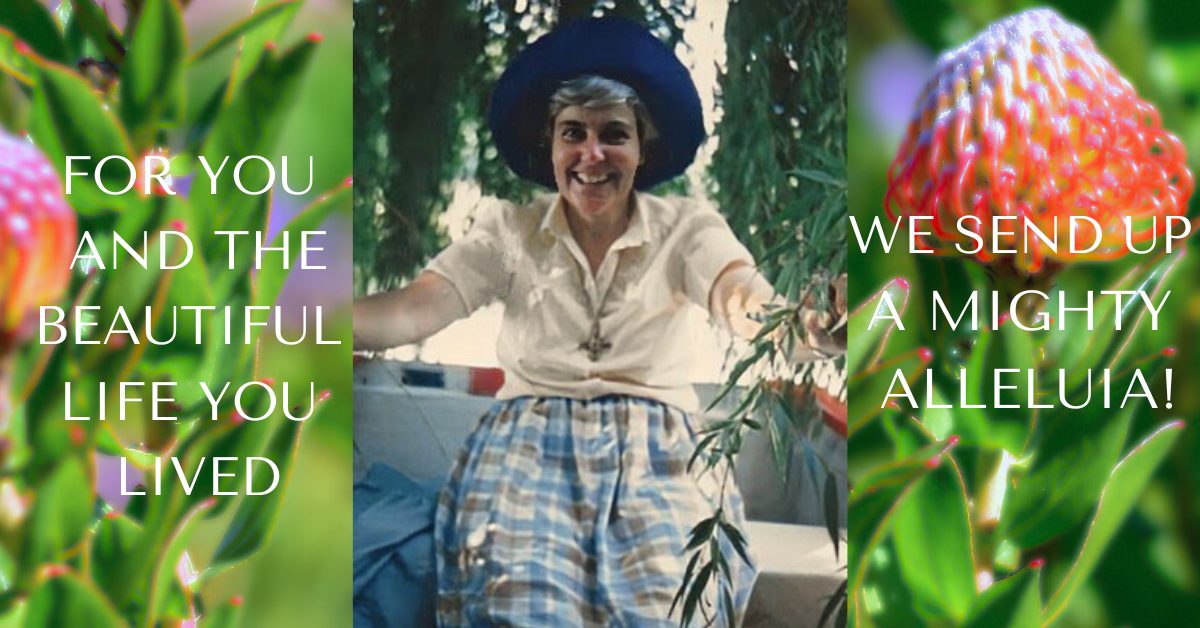
For you and the beautiful life you lived,
We send up a mighty ALLELUIA!